Forex trading journal importance
Retail forex failure rates are not a secret. Broker disclosures filed under European regulatory requirements consistently show that roughly 70 to 85 percent of retail accounts lose money over any given quarter. The figure varies by broker and jurisdiction, but the direction never changes.
What does change, and what rarely gets examined honestly, is why.
The standard explanations point to leverage, undercapitalization, or poor strategy selection. Those factors matter. But they describe symptoms more than causes. A trader using 1:30 leverage with a tested edge can survive. A trader using 1:10 leverage with no record of past decisions usually cannot, because there is nothing to learn from.
This is where the absence of a journal becomes structurally damaging. Without a record, every trade exists in isolation. Wins feel like skill. Losses feel like bad luck. The same setup gets repeated under different market conditions and produces different outcomes, and the trader has no way to tell which variable mattered.
That is not trading. That is guessing with money.
What a forex trading journal actually is
A trading journal is not a diary. The distinction matters because the word itself misleads beginners into writing sentences about how a trade made them feel, then abandoning the practice within a month.
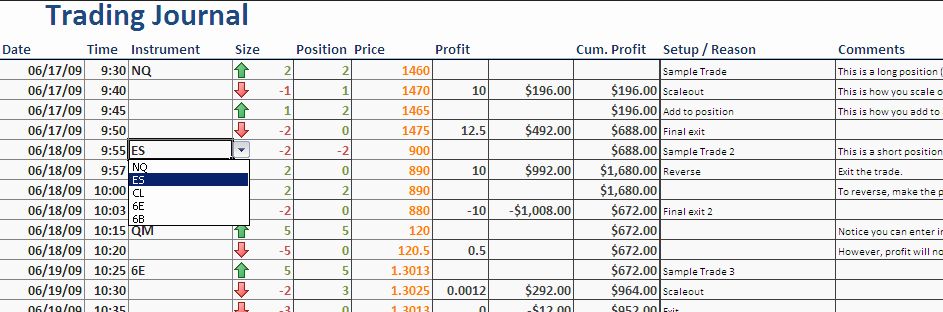
A journal is a structured record. Every position taken, every parameter that defined it, every outcome it produced — logged in a format that can be filtered, sorted, and analyzed later. The unit of analysis is the trade, not the day.
Some traders use spreadsheets. Others use platforms built for the purpose, such as Myfxbook or the analytics tools embedded in MetaTrader 4 and MetaTrader 5. The format is secondary. What matters is consistency and the discipline to record entries before bias contaminates the record.
The trader is building a dataset on themselves, and the dataset only works if it is honest and complete.
The core data every journal should capture
Entry price, exit price, stop-loss level, take-profit level, position size in lots, currency pair, date, and time. These are the minimum fields. Without them, no analysis is possible.
But the minimum is rarely enough.
Strong journals also capture the reason for entry — not "I thought it would go up," but the specific signal or condition that triggered the trade. A break of a prior session high. A retest of a daily support level. A divergence on the four-hour chart. The reason has to be recorded before the outcome is known, because once a trade is closed, memory rewrites itself.
Risk per trade should be logged in account-percentage terms, not just pip distance. A 50-pip stop on a mini lot in a $5,000 account is a different exposure than the same stop on a standard lot. Pip values shift with the quote currency too, which is where many beginners introduce silent errors.
Screenshots of the chart at entry close the loop. They are the only protection against rationalized hindsight.
How journaling exposes hidden behavioral patterns
Patterns surface in the data that no trader would notice in real time.
Consider a trader who believes their strategy is profitable. They have winning weeks. They have losing weeks. The account is roughly flat over six months, which they attribute to market conditions. Then they sort their journal by day of the week and discover that Mondays alone account for nearly all their losses. The strategy works. The trader's Monday execution does not — perhaps because weekend gaps distort the setups they rely on.
That insight is invisible without records.
Time-of-day filtering reveals similar effects. So does sorting by currency pair, by session overlap, or by whether a trade was taken after a recent loss. Revenge trading shows up clearly in journal data: position sizes creep upward in the trades immediately following a loss, even when the trader insists they followed their rules.
This kind of self-examination tends to trip up even experienced traders, because the patterns are uncomfortable to confront. The numbers do not flatter anyone. That is precisely what makes them useful.
Using journal data to refine strategy and risk management
A journal with three months of consistent entries becomes a working laboratory.
Win rate alone tells you almost nothing. A 70 percent win rate with a 1:0.3 risk-reward ratio is a losing system. A 35 percent win rate with a 1:3 ratio is profitable. The journal lets a trader calculate expectancy — average win multiplied by win probability, minus average loss multiplied by loss probability — and that single number reveals whether the edge is real.
From there, refinement becomes specific. If the data shows a setup performs well on EUR/USD during the London session but loses money on the same pair during the New York session, the rule writes itself. Trade it where it works. Skip it where it does not.
Position sizing benefits in the same way. Many traders discover, only through their own records, that they were sizing too aggressively for the actual variance of their results. A standard guideline holds risk per trade between 0.5 and 2 percent of account equity, but the appropriate figure depends on the strategy's measured drawdown profile, not a generic recommendation.
Common mistakes traders make when journaling
The most frequent failure is selective recording. Winning trades get logged in detail. Losing trades get summarized vaguely or skipped. The journal becomes a highlight reel and stops functioning as a record.
Another common error is logging too late. A trader who fills in their reasoning hours after closing a position is not journaling. They are constructing a narrative that fits the outcome.
Some traders over-engineer the format. Twenty fields, color-coded tags, mood scores from one to ten. The system becomes so demanding that entries get skipped on busy days, and a journal with gaps is worse than one with fewer fields, because the analysis later assumes the data is complete.
Then there is the opposite problem: tracking trades but never reviewing them. Data accumulates. Nothing is done with it. The journal exists but produces no insight, which is the trading equivalent of weighing yourself daily and never adjusting your diet.
Reviewing the record at fixed intervals — weekly, then monthly — is what converts logging into learning.
Tools and formats for building a reliable journal
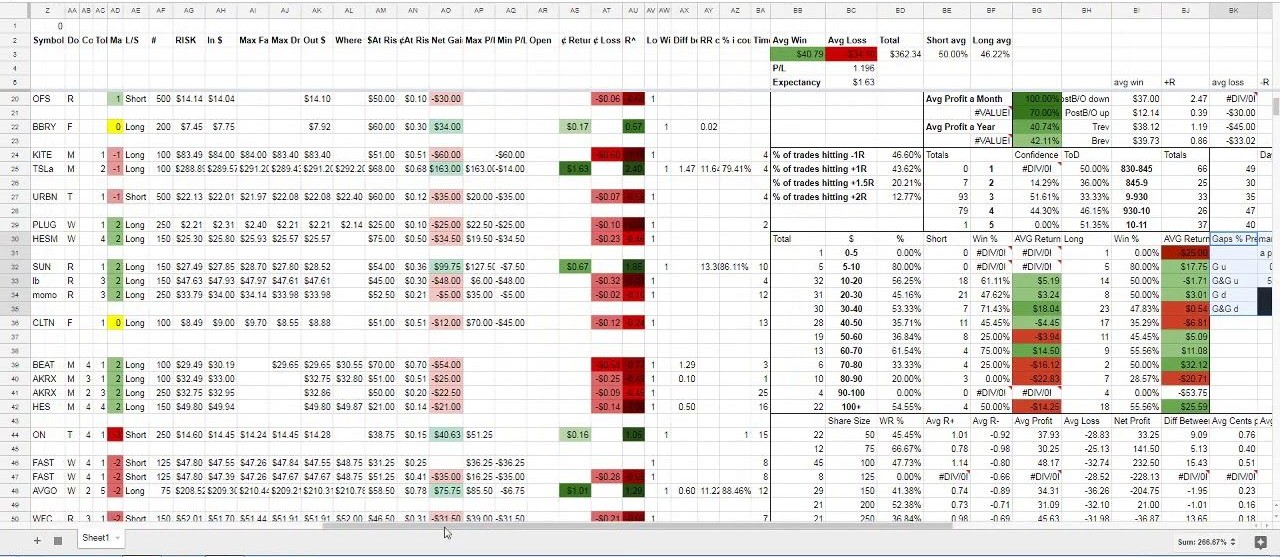
A spreadsheet is enough to start. Excel or Google Sheets, with columns for the core fields, will serve a trader for years if maintained properly. The advantage is full control over what gets tracked and how it is analyzed.
Dedicated platforms add automation. Myfxbook connects directly to most retail brokers and imports trades automatically, then generates statistics on win rate, expectancy, drawdown, and pair-level performance. MetaTrader 4 and MetaTrader 5 produce detailed account statements that can be exported and parsed. TradingView allows annotated chart snapshots to be saved alongside trade ideas, which solves the screenshot problem cleanly.
Each approach has trade-offs. Automated tools save time but can obscure the reasoning behind each trade if the user does not annotate manually. Spreadsheets demand discipline but produce a deeper familiarity with one's own data.
Whatever the format, two non-negotiables remain: entries must be made in real time or immediately after a trade closes, and the data must be reviewed on a schedule the trader actually keeps.
Turning journal insights into long-term trading discipline
The value of a journal compounds. One month of data answers small questions. Twelve months answers structural ones — whether the edge survives different volatility regimes, whether performance correlates with central bank cycles, whether certain pairs behave differently after Federal Reserve or European Central Bank announcements.
That long-horizon view is what separates traders who improve from those who plateau.
Discipline does not arrive through willpower. It arrives through evidence. A trader who has watched their own journal show, in numbers, that oversized positions after a loss erode their account over six months stops taking those positions — not because a rule says so, but because the data has made the consequence personal.
The same applies to setup selection, session timing, and the decision to sit out conditions that historically produce losses. Each of these becomes a rule grounded in the trader's own record rather than borrowed from someone else's playbook.
A journal kept honestly, for long enough, eventually answers the only question that matters: whether the trader has an edge worth scaling, or one worth abandoning.
Conclusion
What is it that separates the profitable forex traders from the less than successful (apart from luck)? Is it their trading strategy. There are a lot of forex trading strategies being promoted. It is easy to come up with a trading gimmick and promise unrealistic performance figures to the unaware retail trader. What is hard to find, however, is the actual performance record of a given trading strategy applied by a specific trader, under their conditions and psychology. That record only exists in so far as someone has gone to the trouble to build it deliberately. A trading journal is the mechanism that produces it. Other components — risk rules, position sizing, session selection, setup filtering — can be refined afterwards, but only to the extent that the trader understands their own historical performance. And that understanding comes from journaling consistently. Traders who treat journaling as optional treat their own improvement as optional. The market is slow to extract the cost of inconsistent trading, but eventually it does, and usually at scale.